
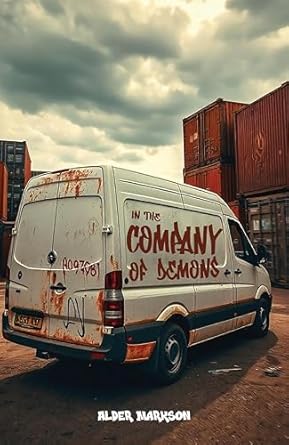
In the Company of Demons is a bold and experimental psychological thriller that takes an unusual setting — a mundane motorway traffic jam on a dark autumn evening — and uses it to explore something far more unsettling than the commute itself. The demons of the title are metaphorical rather than supernatural, and readers approaching this expecting horror should adjust their expectations accordingly. What Markson offers instead is a study of the human psyche, the secrets we carry, and the quiet truth that we rarely know what is really unfolding in the lives of those around us.
The novel follows three consistent characters whose story is told in the third person, interwoven with a rotating cast of secondary characters drawn from the congestion around them, rendered in the first person. It is an ambitious structural choice and one that largely pays off, though the shifts between perspectives do require an adjustment period before the reader finds their footing. Once settled, however, the technique reveals its purpose neatly. As the three central characters observe their fellow travellers — speculating about the person in the vehicle opposite, or the one inching past them — the author peels back the reality behind those imagined lives, delivering a recurring and quietly powerful reminder that appearances deceive and closed doors conceal more than we assume.
The writing is thoughtful and the concept is genuinely interesting. By the nature of the setting, dialogue is sparse — most characters are alone in their vehicles — so it is largely through inner monologue that we experience their worlds. Markson handles this with enough skill to keep it engaging, though the sheer volume of secondary characters does begin to work against the narrative. Moving through so many individual stories makes it difficult to retain a clear sense of each one, and in several places the pace slackens noticeably as a result. The momentum reliably returns when the novel circles back to its three principal characters, which perhaps suggests that a leaner supporting cast would have served the story better.
Whilst action is limited for much of the novel — constrained by the very nature of characters largely remaining in their vehicles — the book finds its footing in the final stretch, where shorter chapters inject a welcome urgency and pull the reader forward. It leaves enough unresolved to make book two an intriguing prospect, though if the secondary drivers are to feature again, some editorial pruning of the wider cast would go a long way.
I award a solid 4 stars.
