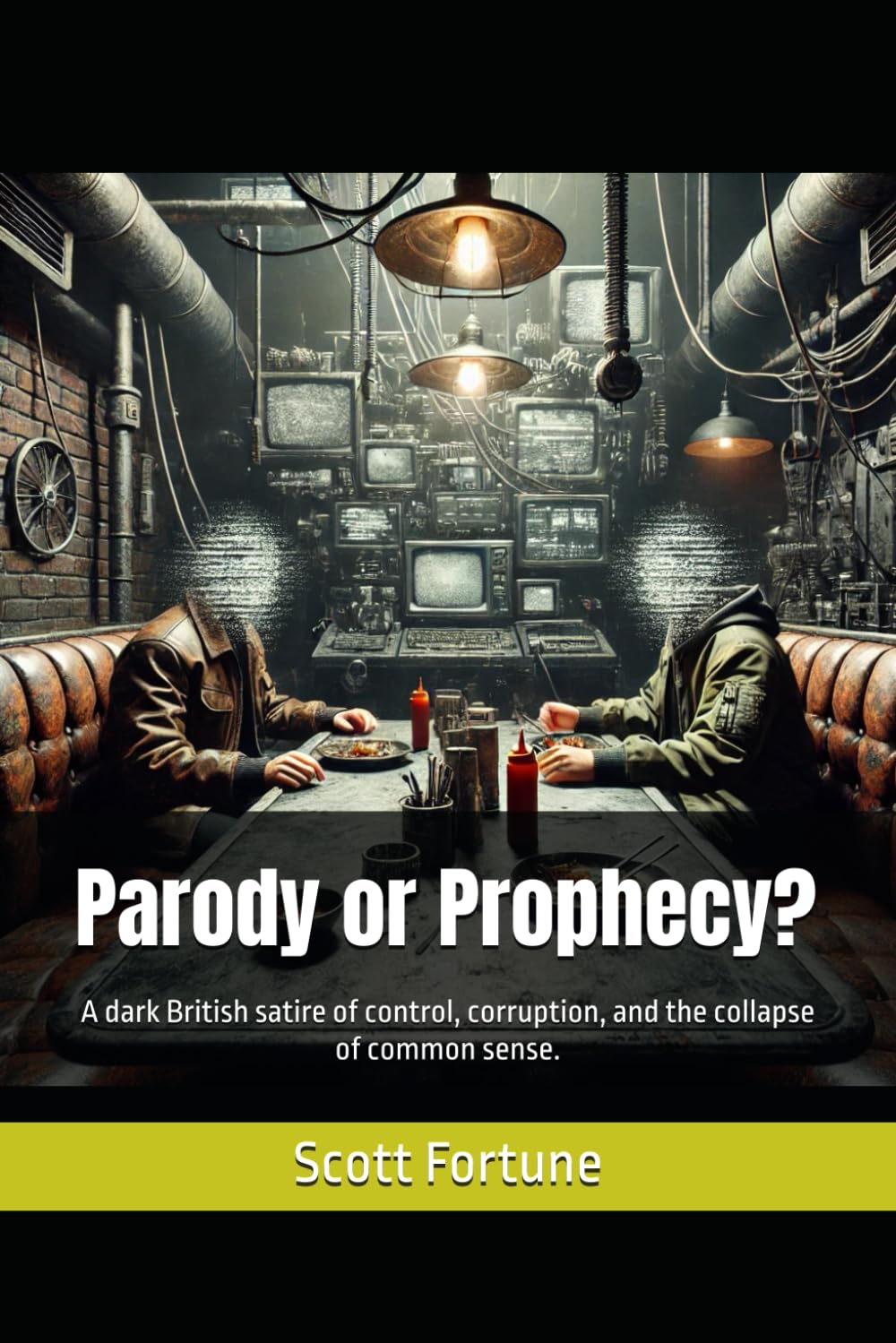
Scott Fortune, known for his viral satirical social media posts, brings his sharp wit and dark observations to book form with Parody or Prophecy?, a dystopian reimagining of the United Kingdom as “Britopia”—a nightmarish vision of 2029 where surveillance drones, corporate tyranny, and governmental absurdity have replaced what remains of democracy. The result is a thought-provoking if somewhat uneven reading experience that succeeds in its scathing commentary but stumbles in its execution.
Fortune’s premise is genuinely unsettling in its plausibility. From curfews enforced by drones to the privatisation of oxygen, the scenarios presented require disturbingly little suspension of disbelief. This is satire that cuts close to the bone, and Fortune’s background as a social media satirist shines through in his ability to identify the logical endpoint of current political trends. The book successfully blends Orwellian darkness with elements of absurdist humour, creating moments that are simultaneously darkly funny and deeply disturbing.
However, the novella’s greatest strength—its unflinching examination of where Britain might be headed—is somewhat undermined by significant structural issues. The formatting is notably problematic, resembling social media posts more than traditional prose. Whether this was a deliberate choice to mirror Fortune’s social media origins or an oversight in the transition to book format is unclear. More fundamentally, Parody or Prophecy? reads as commentary rather than fully realised fiction. The book tells rather than shows, presenting ideas and scenarios through narrative exposition without the grounding presence of developed characters or dialogue. We observe Britopia from a distance rather than experiencing it through the eyes of individuals struggling within the system. This approach feels like a missed opportunity—Fortune’s sharp observations would have been infinitely more powerful if woven into actual character journeys and dramatic scenes.
The book would have benefited enormously from being fleshed out into a longer, more traditional narrative structure with fully developed characters navigating this dystopian landscape. Dialogue and personal stakes would have transformed this from an interesting thought experiment into a truly immersive and engaging read. As it stands, the novella feels more like an extended essay or manifesto than a complete work of fiction.
That said, there’s undeniable power in Fortune’s central conceit. The most chilling aspect of Parody or Prophecy? is how little imagination is required to envision these scenarios becoming reality. The trajectory from Britain’s current state to Britopia doesn’t require a huge leap—just a continuation of existing trends taken to their logical, horrifying conclusions. This proximity to reality is both the book’s greatest achievement and its most unsettling quality.
For readers unfamiliar with this style of political satire, it’s difficult to say how Parody or Prophecy? compares to established works in the genre. What’s clear is that Fortune has something important to say, and his satirist’s eye for hypocrisy and absurdity serves him well. The question remains whether this material might have been better suited to his original medium of social media posts, or whether with further development it could have become the fully realised dystopian novel it hints at being.
Final Verdict: Parody or Prophecy? is worth reading for its uncomfortably accurate social commentary and its willingness to hold a mirror up to contemporary Britain. However, readers should approach it as political satire and social commentary rather than traditional narrative fiction. The formatting issues and lack of character development prevent it from reaching its full potential, but the core ideas are provocative enough to make it a worthwhile read.
Recommended for: Readers interested in political satire, those who follow Fortune’s social media work, and anyone willing to confront an unsettlingly plausible vision of Britain’s future. Best appreciated by those who value ideas and commentary over traditional storytelling, though one can’t help wishing Fortune had given us both.
The book’s central question lingers: Is this parody—or prophecy? Given the current state of affairs, the answer may be more frightening than we’d like to admit.
I award 3 stars.
Not Currently Available at The Book Dragon or Chapters & Chai
